
Samuel Wright Mifflin
Farmer / Surveyor / Civil Engineer / UGRR Conductor
Born: 2 June 1805, Columbia, Pennsylvania USA
Died: 26 July 1885, Wayne, Pennsylvania USA
Samuel Wright Mifflin was closely associated with the historic Hybla Farm just outside of Wrightsville, directly across the Susquehanna River from Columbia, Pennsylvania. He was the son of Jonathan Mifflin and Susanna Wright (not the Susanna, daughter of John Wright). The Wrights and Mifflins were both strong abolitionists with views rooted in their Quaker faith. After the death of his parents, Samuel inherited Hybla and continued the family’s role in providing refuge and support to freedom seekers escaping slavery.
Samuel's father was Jonathan Mifflin (1753-1840), a Quaker Lieutenant Colonel and Deputy Quartermaster General during the Revolutionary War, directly under the command of General Thomas Mifflin (later, Pennsylvania's first governor). Jonathan also reported to Commander in Chief, George Washington.
Samuel's mother was Susanna Wright Mifflin (1764-1821), daughter of James Wright. When her father died in 1788, Susanna received a 108-acre tract west of the river in what became Hellam Township, York County, including the hilltop site where Hybla would be built. When she married Jonathan in 1880, they built (or substantially improved) a substantial stone dwelling on her tract and named the farm “Hybla,” which became their principal residence for the rest of her life. Samuel would inherit this property on the death of his parents.
At age 32, Samuel Wright Mifflin was already enough of a specialist in railway geometry to publish a technical manual, Methods of Location: Or, Modes of Describing and Adjusting Railway Curves and Tangents, as Practiced by the Engineers of Pennsylvania. When the Pennsylvania Railroad undertook its main line across the state in the late 1840s, S. W. Mifflin is described as a “gentleman of well‑known professional skill and experience” put in charge of one of the key survey corps. He had responsibility for surveying the stretch from the Raystown Branch of the Juniata to the Allegheny summit, described as “the most important and difficult district” on the eastern route to Pittsburgh because of the heavy mountain work. He served as one of the principal assistants to William B. Foster Jr., associate engineer for the Eastern Division, and is later referred to as chief engineer for the mountain division from Jack’s Narrows to the Allegheny summit. Indeed, he was instrumental in helping supervise the construction of the Horseshoe Curve and the Allegheny Tunnel.
Beyond railroads, S. W. Mifflin co‑produced detailed urban surveys, including an 1849–1851 “Map of the Borough of Germantown” compiled from actual surveys by J. C. Trautwine and S. W. Mifflin, civil engineers, for Philadelphia councils. This kind of municipal mapping work shows him applying his surveying skills to civic projects as well as to long‑distance transportation lines.
Samuel married Elizabeth Brown Martin in 1843. They raised four children: Susan Wright Mifflin (1846-1927), George Brown Mifflin (1847-1934), Eliza Brown Mifflin (1850-1942), and Robert Wright Mifflin (1853-1923). Later, Samuel married Hannah Wierman in 1851. It should be noted that George Brown Mifflin, in 1870, married the love of Lloyd Mifflin's life, Barbara Hörnli Peart. Both George and Barbara are buried in Oaks, Montgomery County, Pennsylvania.
In the early 1880s, Dr. Robert Smedley features Samuel W. Mifflin in his work History of the Underground Railroad in Chester and the neighboring counties of Pennsylvania. The account offers multiple stories of fugitives staying on the Hybla property, in the home, as well as being shuttled across the Susquehanna. Each short narrative showcases an important element or principle of the Underground Railroad’s operation.
Far back in his boyhood, Samuel remembered being accustomed to seeing fugitives passed along by different members of their family. On one occasion, he recalled a freedom seeker was hidden in a cornfield and fed day after day by a cousin. The cousin would go out with his gun as if to hunt but his game bag was filled with provisions. It was very common for Quakers or abolitionists to offer a safe location on the property but not necessarily in the home. Cellars, barns, and in this instance, cornfields could be used to conceal freedom seekers, allowing them a few hours or days rest and recuperation before continuing their journey.
On a visit home to see his ailing father, Samuel found “the parlor occupied by thirteen fugitives. They comprised two families of men, women, and children whom his elder brother found wandering in the neighborhood. The windows were closed to prevent discovery, and a lamp kept burning all day. They were thus guarded during two days and nights of stormy weather and high water in the Susquehanna which prevented their crossing the river. On the third night they were transferred to the care of Robert Loney who ferried them over to the Columbia shore.”
Samuel Wright Mifflin and his wife, Elizabeth Brown Martin, are buried together in the oldest section of Mount Bethel Cemetery, Columbia, Pennsylvania.

Samuel Wright Mifflin as a surveyor painted by Lloyd Mifflin's father, John Houston Mifflin, in 1832.
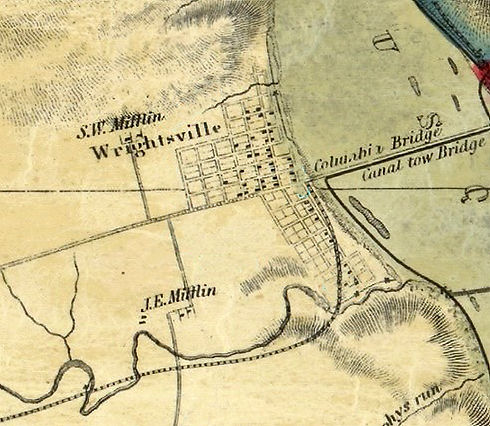
Segment of a circa 1860 map of the Wrightsville area showing Samuel Wright Mifflin's property (Hybla) and that of Samuel's cousin, James Ewing Mifflin.